The Life and Legend of Alexander McQueen
The Life and Legend of Alexander McQueen
 by
by Fashion’s Greatest Triumph
Alexander McQueen revolutionized fashion. He is considered to be one of the most influential and innovative fashion designers of all time. He was an absolute visionary and creative genius. Going on 12 years since his passing, and being that he is one of my favorite designers of all time, I have been looking forward to doing a blog post to memorialize him!
Early Years
McQueen was born on March 17, 1969 to humble beginnings being 1 of 5 children supported by a cab driver father and teacher mother. His mom taught sociology which could have been the origin for some of McQueen’s later fascination in the subject being shown through his designs and shows. Alexander McQueen, called Lee by his friends for most of his life, recognized his own homosexuality at an early age and was teased extensively about it by his classmates growing up. Finally, at age 16, McQueen dropped out of school and found work as a tailor on Saville Row- London’s Mayfair District famous for offering made-to-order men’s suits.
Professional Beginnings
McQueen moved on from tailoring on Savile Row after a short time and began his clothes making career designing theatrical costumes with designers Angels and Bermans. This helped him to practice the dramatic style of clothing that would later define his work. McQueen then left London and ventured to Milan for a short while where he work as a design assistant to Italian designer Romeo Gigli.
Upon his return to London, McQueen enrolled at Central Saint Martin’s College of Art and Design in 1992. He received his masters from there and his final project, which was his own collection inspired by Jack the Ripper, was famously bought in its entirety by eccentric London stylist that would become a long time friend to McQueen, Isabella Blow.
Soon after finishing his master degree, McQueen started his own business designing clothes for women. He became fairly successful quickly in doing this with the introduction of original designs including the “bumster” pants, named that for their extremely low-cut waistline. It was only 4 years after graduation that Alexander McQueen was named Chief Designer of Louis Vuitton-owned Givenchy, a French haute couture fashion house still popular today.
McQueen would later say that the job “constrain[ed] his creativity” and that he was in it for the money there which was treating Givenchy badly. He says “The only way it would have worked would have been if they had allowed me o change the whole concept of the house, to give it a new identity, and they never wanted me to do that.” Regardless his reservations, McQueen was able to win British Designer of the Year in 1996, 1997, and 2001, all during his 5 years at Givenchy.
The Alexander McQueen Brand
McQueen was still working on his own brand which he started in 1992 while at Givenchy and in 2000, Gucci bought a 51% stake in Alexander McQueen’s private company and provided him the capital that he needed to expand. McQueen left Givenchy shortly after. With the help of Gucci’s investment, McQueen became significantly more successful than ever before and was awarded another British Designer of the year award as well as was declared International Designer of the Year by the Council of Fashion Designers of America and a Commander of the most Excellent Order of the British Empire by the Queen of England. He also opened up stores in New York, Milan, London, Las Vegas, and Los Angeles. All the while, McQueen was not shy about his lack of traditional good looks and lower class background. For a world-renowned designer he was often seen wearing less than fashion forward attire with casual and even frumpy fits. McQueen was proud to be where he had made it from where he came from and was happy to be breaking down the traditional mold of a successful designer.
The Shows and The Fashion!
Watching an Alexander McQueen fashion show guarantees never a dull moment. As mentioned previously his focus on sociology and his influences are profound and his shows and the fashion involved maintain a consistent theme throughout while never being repetitive, which based on most designers inability to mimic this, is seemingly a pretty difficult thing to do. McQueen’s models also played a part in this, having more of a theatrical role in his shows than most others requiring them to more than look beautiful in his clothes, but also to play the part as you will see in many of these.
Some of my favorite McQueen shows in no particular order including links for your viewing pleasure are as follows: !
Spring/ Summer 2001: “VOSS”
VOSS was staged to look like a psychiatric ward floor. The set however was staged in box that was made of mirrors. The show also deliberately started 2 hours late so that the audience sat and stared at themselves in the mirrors before the show which most described as very awkward. I may be reaching here, but my interpretation of why he did this was to get the audience to analyze themselves here and possibly going for a Madhatter “We’re all a little mad here” moment. As someone who was placed in a psychiatric ward for a short time, I do hope that’s the case. These mirrors we’re double sided as well. SO, when the models did come out, instead of seeing the audience react to them, as per usual, they only saw themselves, which probably helped to put them into character for the show. The entire show was very theatrical with models staying perfectly in character for its entirety, some danced freely inside the box, perhaps to represent a delusional or disassociated person in an asylum, some stuck their faces right up against the wall, one laughed hysterically at her own reflection, and one even began to tear the the dress she was wearing apart that was on her, perhaps symbolically releasing her from its confines.
The models wore head coverings to look like bandages. In an interview with Alexander McQueen, he described the bandages as representative of surgery- surgery to change the way you are. The styles themselves were out there. Some looking as if they were designed by a crazy person, I think McQueen was looking to play into the role of crazy playing such a significant role in high fashion and creative fields in general. He danced the line between crazy and genius so that you could determine your own- What was crazy enough to work? From a marketing perspective this tactic was genius. I think this could also serve to show politically that the level of patients required care even within the system varies a lot and was likely also saying something about how we treat these people within the system. Then, to end the show, the last model left the stage then the glass box in the middle began to open and each of the sides shattered revealing another model, this one naked, reclining in a chair with moths all over her that flew in all directions once the box fell, finally free from it’s constraints.
Watch S/S 2001 “VOSS”:

Some of my favorite looks:

The skirt is made of Ostrich Feathers dyed red and black, while the bodice is made out of microscope slides painted red to represent blood. “There’s blood beneath every layer of skin”- Alexander McQueen
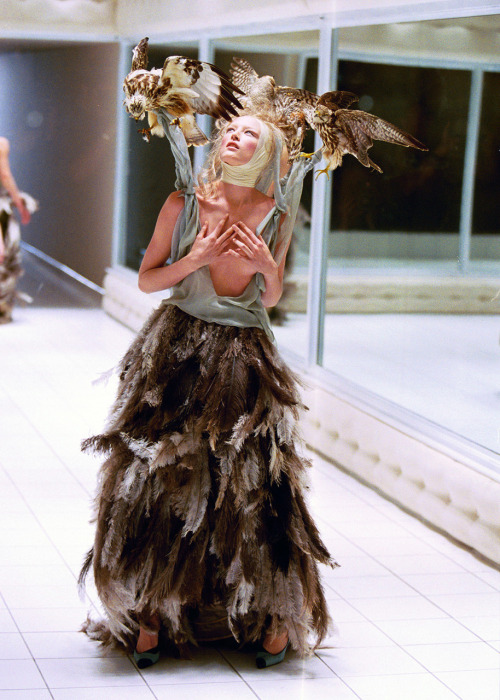
A dress inspired by the Alfred Hitchcock film “The Birds” (1963) McQueen used the influence of birds in many of the pieces of this collection and the name Voss actually came from a Norwegian town that is most widely known for its wildlife habitat and especially its birds.

McQueen draws a lot of his inspiration from other nature, well exemplified here in this underdress made of oyster shells and a neckpiece of silver and Tahiti pearls. Japanese influence was also prevalent throughout some of this collection. This dress has panels from a nineteenth-century Japanese silk screen as well. The model wearing this outfit was shown playing with the top decor in her mouth.

Here are a couple of interesting pieces from this collection. The front features a bodice composed of puzzle pieces, while the back features a castle shoulder piece.

This is the dress that the model was shown tearing apart, I mentioned previously. It is composed almost entirely of razor-clam shells McQuen collected from a beach while on his honeymoon and was one of, if not the most talked about pieces from this collection.
Spring/ Summer 2010: Plato’s Atlantis
Platos Atlantis was McQueen’s final show, and as expected, was revolutionary. The show speaks of climate change and set is composed of machines and technology, but the work is strongly inspired by nature. The prints are of insect, reptile, and butterfly patterns with gorgeous symmetry and the clothing for this show was constructed on the human body to perfect the 3 dimension feel. It is about a dystopian future and feels very sci-fi. McQueen foresees a world underwater and models half-human and half-bionic.
This finale of this show was the premiere of Lady Gaga’s “Bad Romance” and it was the first live streamed fashion show ever. He live-streamed the video making this show an immersive experience like none other before. This has become commonplace to do now and McQueen was instrumental in breaking down this barrier of exclusivity in the world of high fashion for us today.
Watch S/S 2010 “Plato’s Atlantis”:
Some of my favorite looks:

Look 1: The show started with a large projection and showcased the models tied down with snakes crawling across them. I think what he was getting at here was that they turned into these half-human half-bionic creatures from these snakes biting them, similar to Spiderman and I think this is pretty realistic because as fabulous as they all look you would have to be bionic to wear those shoes.

These are the Armadillo shoes that McQueen first presented with this collection and his most celebrated footwear creation. They combined a claw-like menace with the beauty of a ballerina’s en pointe. The shoe also has a historical precedent in an exaggerated form of sixteenth-century Persian riding boots.


Look 28: The metamorphosis dress. To McQueen, metamorphosis had similar qualities to plastic surgery, but he uses this hybrid dress to transform mentality more than the body.

Look 40: This look features a dramatic bubble like shoulder and collar that. I will say that even though this is indeed one of my favorite collections by McQueen, it does have less variety than some of his others.


The final piece: AKA The Jellyfish is an all studded bubble mini dress and pants with 3 quarter sleeves and a high neckline. The colors of this dress changed according to the light thanks to iridescent paillettes. It is a real statement and one of my favorites by McQueen.
Spring/Summer 1999: No. 13
Making a statement regarding advancements in technology taking away our jobs, which was a real fear for many people back then and still is for some today, No. 13 predominantly showcases a new take on female professional wear and sticks to predominantly neutral colors.
Although the clothes are stunning and there are several innovative cuts used, the real showstopper was the final piece of the collection, which audience members were able to see finalized firsthand as was completed on stage by electric arms as the model quivered in fear.
Watch S/S 1999: “No. 13”:
Some of my favorite looks:

Look 68: This is a sheer nude dress covered in a sheer shiny fabric with a triangular patten separating the top and the skirt and box shaped motif on the top covering the head. I think that McQueen was going for jobs keeping you in a box here.


Look 72: McQueen leads up to the finale gown with a few white pieces. This one similarly features a creative use of a belt. Different elements of bondage were sprinkled throughout this collection.

Then the finale dress began like this:

And post one of the most iconic spectacles in the world of fashion to date… became this!
His Untimely Demise
McQueen struggled immensely throughout his life with drug abuse. In interviews he claimed his fashion sense embodied sex, drugs, and rock n roll. So, to would be his downfall. Namely cocaine was his drug of choice. McQueen used the drug consistently, claiming that it helped with his back pain, helped him to keep up with the pressure of deadlines he was subject to, and whelped him to lose weight, which was something he was incredibly self-conscious about to the point he even had lyposuction to fix unsuccessfully at one point. After the Gucci Group bought stake in his company and McQueen his work had become so negatively affected by his drug abuse, his new bosses and coworkers had to stage an intervention with him where he admitted the drugs made the clothes “more erratic.” He did try to get himself clean for a bit after this, even attending rehab only to leave after the first day because it was so poorly run, but this didn’t last long and McQueen’s staff got to the point where they had to ask the venues at his shows and events that McQueen have a designated private room in which he could do his drugs. This ongoing struggle, paired with a series of unfortunate endings in his love affairs including his husband leaving him and leaving him with an STD, was worsened significantly when, in 2007, McQueen became better acquainted with the idea of suicide. His long-time supporter and good friend Isabella Blow- the stylist that bought his Jack the Ripper fashion line- committed herself to such fate that year. McQueen dedicated his 2008 Spring/ Summer line to Blow. He refers to the experience of losing her as “the most valuable thing I learnt in fashion.” Then, two years later, McQueen’s mother lost her battle to cancer that McQueen was dealing with mostly privately for years. It was a day before his mother’s funeral on February 11 2010 that Alexander McQueen was found dead in his Mayfair, London apartment. He was only 40 years old and the cause of death was suicide. His last line was officially Plato’s Atlantis but he finished about 80% of his next line before his death, which is called Angels and Devils.
The Legacy
McQueen’s rise from high school dropout to internationally famous designer is a remarkable story. His fascinating shows and bold styles impressed the world and have made a lasting impact on the fashion world. Alexander McQueen’s brand is still operating today and continuing to wow the fashion world as longtime co-designer Sarah Burton took over in the face of his passing.
McQueen’s fashions are honored today by a 2011 exhibition of his creations at the Metropolitan Museum of Art in New York City. His life also was memorialized as subject of 2018 documentary McQueen by Ian Bonhôte and Peter Ettedgui. Along with interviews of his family, friends, and associates, the documentary also shows little- seen footage of McQueen himself in interviews, his comments hinting at troubles underneath the surface and foreshadowing his untimely demise to come.
The End
I say the end but McQueen’s influence on fashion is never-ending and I’m sure that I will continue to add more of his fashions to this as restricting myself to the amount that I chose was incredibly difficult. Also, if you want more information on this brilliant designers life, the book I’ve linked HERE was my best resource in writing this and is a high quality biography on the life of both McQueen and long-time fellow English designer and rival, John Galliano. So, let’s be real, bye for now, but you may want to check in monthly or so until I’ve done just about every one of his shows. And if you want to see more, click HERE to see what I think are this visionary’s top 50 quotes about fashion and life! Thanks so much for your support. There’s nothing I love more than sharing this information with all of you and hope to be able to do that for a very long time. So, see you again soon.
XOXO,
Amy
Comments
Post a Comment